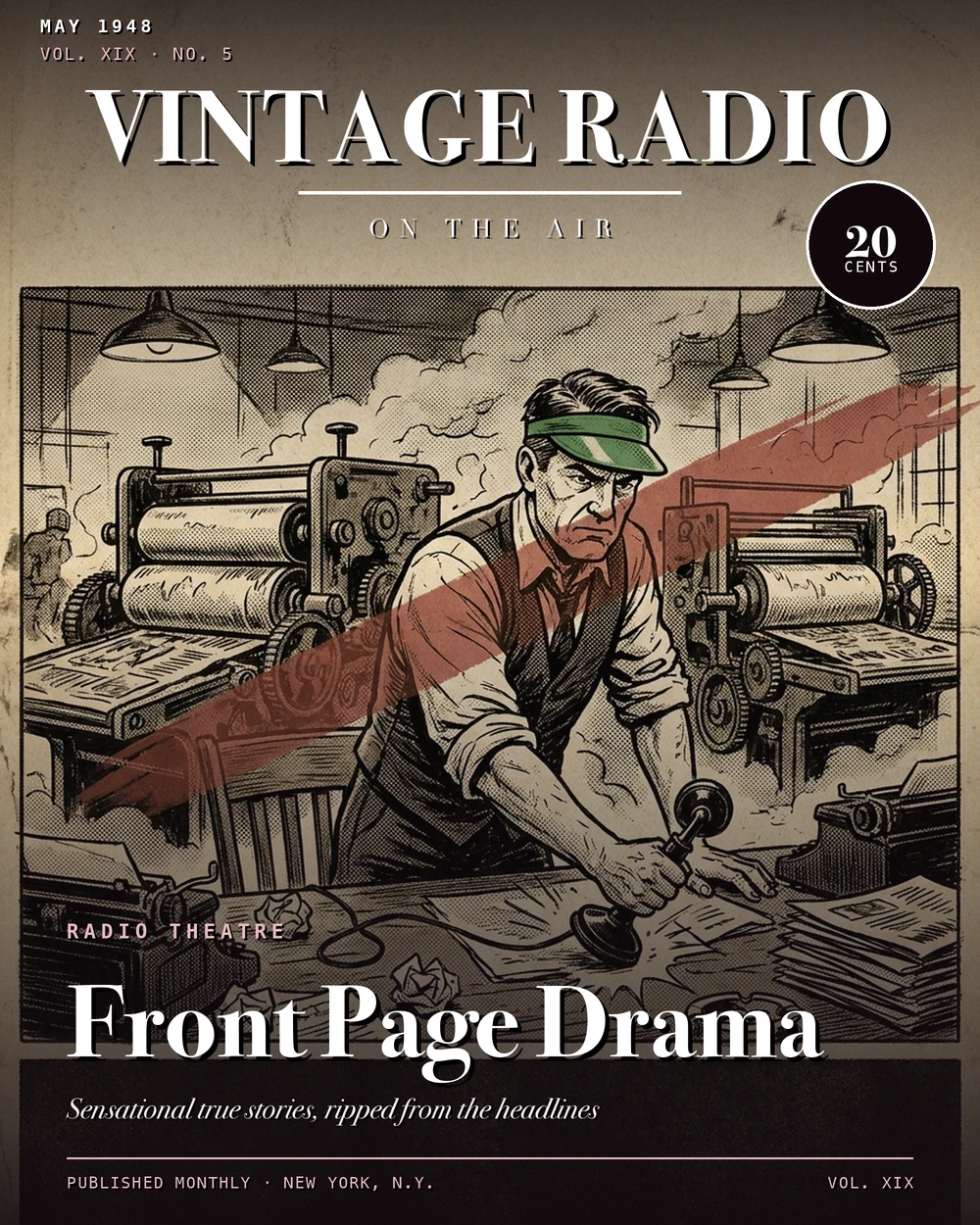
Front Page Drama
The Hearst Machine Behind the Microphone
Front Page Drama was less a journalism show than a print advertising campaign delivered in audio form — and that tension between commerce and storytelling is what makes it genuinely interesting. The series began on April 27, 1933, syndicated by Hearst Newspapers and produced at the studios of The General Broadcasting Company in New York City. Its full broadcast title was The American Weekly Program: Front Page Drama, and the sponsor was The American Weekly, the Hearst Corporation's Sunday newspaper supplement inserted into Hearst-owned papers across the country. The primary purpose was direct and unapologetic: use radio to sell more Sunday newspapers.
Each episode ran fifteen minutes and dramatized a "true life story" drawn from the forthcoming issue of The American Weekly — essentially a weekly trailer for that Sunday's print edition. The formula was clever in the way that good promotional vehicles often are. Give listeners just enough of the story to make them want the rest, then send them to the newsstand. The American Weekly magazine billed itself as reaching more than 50,000,000 readers, a figure that reflected its reach as a mass-circulation Sunday insert, functioning much the way the modern Parade magazine does today. By the early 1950s, Time put the magazine's actual circulation at around 9.4 million — still a substantial readership base that the radio program was built to cultivate.
For its first thirty-six episodes — running from April 27, 1933 through January 4, 1934 — the program went out simply as The American Weekly, before settling into the Front Page Drama name that carried it through to its final broadcast on March 28, 1953. That's twenty years on the air, 177 episodes in surviving catalogs, and a run that outlasted most of the other anthology dramas that followed in its wake.
What Was Actually on the Air
The name "Front Page Drama" conjures a show about reporters racing deadlines, pressing sources, and cracking corruption. The reality was considerably stranger and more entertaining than that. Reporters were rarely the protagonists here. The show dramatized the stories themselves — the sensational, the criminal, the bizarre, and the heartfelt — the same material that made The American Weekly a colorful fixture of the American Sunday. Journalists appeared mainly as background figures when they appeared at all.
The episode titles alone suggest the range: "Venus in Furs," "The Ghost Ship," "The Marie Antoinette Diamond," "The Crown of Kolyapan," "Pirate Group," "The Duchess of Despair." These weren't civic-minded dispatches from the pressroom. They were jewel heists, fraud spiritualists, isolated lighthouse mysteries, alleged pirate treasure maps, courtroom confrontations, and accounts of people declared dead in one state but found very much alive in another. Crime, scandal, human interest, and political intrigue all turned up, but so did a good deal of material that sat closer to the sensational adventure story than to anything approaching investigative journalism.
One 1937 episode, "Girl Reporter," was notable precisely because it was an exception — a cub reporter as central protagonist, trying to prove a big story to a skeptical city editor. The episode stood out because it actually staged the journalistic process that the show's title promised but rarely delivered. Most weeks, the reporting apparatus was simply the mechanism by which a remarkable real-world story had been unearthed and handed to The American Weekly, and the radio drama started from there.
The Show's Reach and Its Influence
Despite its commercial origins, Front Page Drama ran long enough and reached broadly enough to leave a mark on the drama genre around it. The show is credited with helping establish newspaper reporters as a recurring presence in radio drama more broadly — not because Front Page Drama itself centered reporters, but because it normalized the idea of using journalism as the connective thread between a listener and a sensational story, a frame that other programs picked up and developed further. Shows that drew similar audiences included Lux Radio Theatre, Campbell Playhouse, Damon Runyon Theater, Academy Award Theater, and Family Theater.
The program also leaned into themes — ethical compromises in pursuit of a story, the tension between public interest and private harm, the way a sensational account shapes how an event is remembered — that gave it more texture than a straight promotional vehicle might have had. Whether that reflected deliberate creative intent or simply the nature of the source material is hard to say from the outside, but the show's twenty-year run suggests it found and kept an audience that wanted something beyond pure novelty.
The American Weekly itself ran from November 1, 1896 through 1963, when it was renamed Pictorial Living, and folded entirely in 1966. The radio program it sponsored outlasted many more celebrated anthology dramas, which is its own quiet argument for the format's durability.
Paul Keyes and the Career It Launched
The most striking downstream consequence of Front Page Drama may be the career it helped start. Paul W. Keyes, who would go on to win an Emmy as the head writer of Rowan and Martin's Laugh-In, got his start in entertainment directing Front Page Drama for Hearst Radio. He had begun his radio career at the Yankee Network before moving to Hearst, and his work on Front Page Drama gave him the production grounding he needed to move forward.
During World War II, Keyes wrote stories for the Armed Forces Radio Service, experience that deepened his radio credentials and eventually helped him land more prominent work. After the war he transitioned to television, writing for CBS's Omnibus and NBC's Tonight with Steve Allen before joining Laugh-In as its head writer. He also became a political consultant to Richard Nixon — and in that capacity convinced Nixon to appear on Laugh-In and deliver the show's catchphrase: "Sock it to me!" That moment remains one of the more unexpected artifacts of 1960s television, and its origin traces back, at least indirectly, to a fifteen-minute weekly radio drama produced to sell Hearst Sunday papers in 1933.
How It Ended
Front Page Drama ran its final episode on March 28, 1953, closing out a run that had begun during Franklin Roosevelt's first year in office. By 1953, radio drama as a genre was giving ground to television across the board, and a show whose commercial purpose — driving Sunday newspaper sales for a specific magazine — was tied to a print product that was itself losing ground had less reason to keep going than a drama with a more independent identity might have had.
The 177 surviving episodes span two decades and reflect the full range of what The American Weekly offered its readers: crime stories and human interest, the strange and the sentimental, the world as a place full of remarkable things that happened to ordinary people. That breadth, more than any consistent dramatic vision, is probably the most honest way to describe what Front Page Drama was across its long run — a radio anthology that took its stories where it found them and trusted the material to carry the fifteen minutes.